Showing posts with label Follow Jesus. Show all posts

Wednesday, October 30, 2019

So, you want to make disciples - Count the cost!


The Great Commission

And Jesus came and spoke to them, saying, "All authority has been given to Me in heaven and on earth. Go therefore and make disciples of all the nations, baptizing them in the name of the Father and of the Son and of the Holy Spirit, teaching them to observe all things that I have commanded you; and lo, I am with you always, even to the end of the age." Amen. [Matthew 28:18-20 (NKJV)]

Effectively fulfilling the Great Commission is no simple task as you have probably discovered if you have been in ministry for any length of time. Most of us - with good intentions - have been doing it wrong. The problem is in understanding what we are called to do.

Please forgive my suggested books which address the area of discipleship. They do provide help for your discipleship program if you are interested.

Go!

Step one of the Great Commission is, "To go." When we go out of the church and share God's love, God shows up and does wonderful things. St. Patrick was at home in England when a band of Irish marauders kidnapped him, took him to Ireland, and sold him into slavery. Six years later he escaped and fled on a boat back to England.  A few years later, young Patrick had a vision calling him back to Ireland. Talk about getting out of his comfort zone. 
Obeying God, he went back to the nation that had enslaved him. But this time he took the message of God's love. He baptized thousands of people including some wealthy women and the sons of kings. Every day he faced imprisonment and death.

"To go," means to leave your comfort zone, to get out of the church and interact with people who are not like you. It is a mission for the Lord. Leaving our comfort zone can be very scary, but that's where we will see God in action. 

Sharing the love of God with a stranger is not easy for most people. It is especially difficult when people are radically different from us. But Jesus calls us to GO. And as we go He can work through us. To paraphrase C. S. Lewis, "A small rudder can turn a big boat as long as the boat is moving. But when it is sitting still the rudder has no effect."

In the Gospel of John, Jesus was on His way from Jerusalem to Galilee. Tired and needing rest, He stopped at Jacob's well while His disciples went into Schecham to fetch food and drink. You know the story. A Samaritan woman comes along, Jesus asks her for a drink, and they dialogue for a while. Jesus knows her heart and shares the "Good News" with her in an interesting way. She believes and GOES into town to tell her story to everyone there. She left her comfort zone. The townspeople came out to meet this Jesus, and they also believe.

Make "Disciples"

Make disciples is a faulty translation of this passage. A better translation would be to "disciple all nations." So we do not make disciples, we disciple people. The word that is translated "disciple" is the Greek word "Mathetes." In ancient Greece, it was an individual that attached himself to master craftsman, teacher, or leader in order to be mentored by them. In our present world we might use the term "apprentice," the way in which electricians, plumbers, etc are accredited. 

Since becoming a disciple is a purely voluntary act it cannot be forced upon someone or made it a requirement. Postmoderns rebel at coercion. This could be the cause of the church losing its young people as soon as they get outside the influence of the church and home.

The implications of voluntary discipleship are far-reaching. First discipleship, is not programmatic, it is relational. The discipler, must have something significant that the potential disciple wants to become. 

The relationship between the discipler and disciple must be close. It must be so important that the disciple gives up other desires and reaches out to enter into the relationship.  On the other side, the discipler must be perceived as worthy of the relationship. We great resource for becoming the leader others want to follow

Second, if discipleship is voluntary, the discipler must present discipleship as important to the disciple. In other words, he must provide a solid justification and present the benefits of discipleship. 

Lastly, since discipleship is relational, it should be obvious that it is an interpersonal activity between the discipler and the disciple. The discipler has a responsibility to the relationship. If he is not willing to spend the time necessary to maintain the relationship, he will not be an effective discipler. 

Baptize

Romans 6:4 We were therefore buried with him through baptism into death in order that, just as Christ was raised from the dead through the glory of the Father, we too may live a new life.

The Christian church has a variety of understandings and practices of baptism, but Baptism is the entry into the body of Christ. In Baptism you are baptized into the community of Jesus Christ. The church proclaims that you are loved and wanted and a child of God in baptism.

Water is a symbol of purification. It is used to mark the beginning of a new life. In water baptism we are transformed from death to life, rising as a new person, born anew. Satan no longer has a hold on us. The early church included an exorcism in their baptismal rite which is continued in Orthodox Christian churches today. 

Teach

When teaching a disciple, the discipler has the responsibility to help the disciple learn. As teachers we all have our own style of teaching. However, discipling is more relational than the transfer of knowledge. Therefore it is incumbent upon the discipler to understand that people do not all learn the same way. The discipler must make allowances for the disciples learning style.


Jesus' methods of Discipling.

The first thing we notice about Jesus' methods of discipling is that He spent time
with the twelve. Each time He demonstrated something it became a teaching moment. He would use their questions about what just happened to teach a principle.

  1. Demonstrate: With the twelve standing by, Jesus healed the sick, cast out demons, calmed the storms, raised the dead. Each miracle demonstrated His mission; to destroy the works of the enemy - Satan.
  2. Explain: After demonstrating His power, Jesus explained to His disciples why He was able to accomplish the task while they were not
  3. Instruct: Then He instructed them on how to go forth and minister to the needs around the country.
  4. Send: He sent them out two by two to heal the sick. He gave them an opportunity to minister without Him standing over their shoulders.
  5. Critique: When they returned He gave them a critique of how they did and cautioned them as to what was important.

Your Cost

If you choose to take on this vital role, you must count the cost in your time, your emotions, and your freedom. But there is nothing as rewarding as seeing your efforts come to fruition as new people step into leadership and expand the Kingdom of God.

  1. You can only disciple a few people at a time.
  2. You must invest time and resources into each one.
  3. Some will drop out and cause you much pain.
  4. Do you have the time?
  5. Do you have the Patience?
  6. If so, Go!


Wednesday, September 25, 2019

Are you happy with yourself?


Are you happy with yourself?

  • Do you wish that you were older or younger? 
  • Would you rather have been born in a different era? 
  • Do you wish you were born of a different sex? 
  • Do you wish that you had different parents? 
  • Do you wish that you had a different body?

As I pass the remarkable age (for me) of four and a quarter score, I wonder how I made it this far. In 1955 as a student at Georgia Tech, country singer Faron Young's hit song became a favorite of mine. 

"I want to live fast, love hard, die young,
and leave a beautiful memory.” 

That song became my battle cry! Thank God, the third item of my plan failed.

That leads me to an important personal insight. I have always been most happy to be the age that I was at the time. 
  • I guess in college, I was having so much fun - almost flunked out – that I was not looking forward to growing older. 
  • It was fun in my late twenties to be the Young Turk fighting to change the status quo in an institutionalized company that was dying. 
  • In a mid-life crisis, I was happy with a less stressful job and a supportive family. 
  • I am still happy at my present age even though my body is wearing out and I can’t do the things that earlier I thought I could not live without. Now there are exciting new things to do. 

Don't believe that you are too young or too old to do what you are called to do.
Just because I can no longer play golf it isn't the end of life.

Am I happy with myself?

No! I fall short of God’s target so often. A quick review of my past reveals any number of regrets, some as a direct result of the plan for my life - sung by Faron Young.

  • I wish that I had learned how to love at an earlier age. 
  • I wish that I had spent more time with my wife and children rather than chasing fame and fortune. 
  • I wish that I had learned to sing. 
  • I wish that I was better playing the guitar. 
But all in all, I am pretty content.

Getting back to the questions that started this issue, I am content with my age today with all of its pains and medical issues. 

My lifetime has seen tremendous progress:
  • from crystal sets to flat-screen TV’s - 
  • from Ford Tri-motors to supersonic intercontinental transports 
  • from 4th of July Roman Candles to ICBM's, landing men on the moon, and exploring the moons of Uranus 
  • from mechanical adding machines to microcomputers and the internet - 
  • advancements in medicine and medical devices which helped me live this long. 
Not only did I watch this progress but was actually able to participate in some.

What an era to be alive!


My parents were far from perfect, but I could not imagine having any others, they made me who I am today. 

While my body was never perfect, it has taken me where I needed to go, not as a professional athlete, but good enough to not embarrass myself on the golf course or bowling alley - that is until I got too old. I would never have made it as an underwear model, but my body has been good enough for what God has called me to be.

Are you happy with yourself?

Do you realize, that God created you the way you are?

  • He wanted you born in the era in which you were born. 
  • He created you as a male or female based on His plan for your life. 
  • He gave you the parents that you had. 
  • He gave you that body.

If you are unhappy with your present age, the era in which you were born, your sex, your parents, or your body, then your problem is with God. He created you for a purpose by putting you in this world in this place, with those parents, and gave you the body for a reason:

To fulfill His purpose in your life.

Do not rebel against  God’s plan for your life!


Saturday, June 22, 2019

What Motivates one to Become a Disciple


What motivates people to be disciples –  followers of God!

After many years of knowing about God, I began to read biographical books of Christians disciples in the workplace. Often these people faced with difficult problems in their secular jobs and asked God to help them. The testimonies were impressive. How could Jesus know about astrophysics or electronics?

Several years ago while doing research for a book, we conducted a survey to investigate what motivated people to follow Jesus. Here are the questions we asked:

·         When did you realize there was more to your faith than just attending church?
·         What were the circumstances that caused you to go deeper in your relationship with Jesus?
·         Was there another person who modeled maturity or challenged you to seek more from God?
·         How did that person help you grow?

Motivated by Need

The responses were interesting in that most respondents were motivated by need. Less than 20 % were swayed in a church service, a revival, or special events. Continuing support for a deeper walk with God resulted from the ongoing care of a small community such as a home group. In almost every case a mentor or faith community continually challenged each to continue to grow.

In the fifth chapter of Luke’s Gospel, we see an encounter between Simon Peter and Jesus in which Peter realizes that Jesus is more than an itinerant rabbi. Simon had followed Jesus around for several months as his ministry spread in Galilee. He watched as Jesus turned the water into wine at a wedding in Cana. He had seen Jesus heal people of all kinds of diseases and cast out several demons.

So when Jesus was teaching at the Sea of Galilee he didn’t mind letting Him use his boat as a platform from which to teach. Then, when Jesus finished and the crowds dispersed, He turned to Peter and offered him a gift.


“Simon, take your boat out into deep water and let down your nets.”


“Nobody fishes in broad daylight in the Sea of Galilee.thought Simon. “This Rabbi grew up in a carpenter’s shop. He may know theology and wood-working, but he sure doesn’t know fishing. But I’ll humor Him.”

In spite of Peter’s doubts, they caught so many fish that their nets were about to break. So Simon called James and John to come and help pull in the greatest catch of their lives.


Realizing now who Jesus was, Simon fell to his knees and begged Jesus, “Oh Lord, depart from me for I am a sinful man.”

Peter, a fisherman, had a need for fish to provide support for him and his family. Apparently, Jesus knew more about fishing than Peter realized! 

Jesus merely replied, “Come and follow me.  I will make you fishers of men.”


My Sea of Galilee experience came when asked to investigate a problem on one of the Navy's newest and most complex ships. As an electronics engineer, I understood the principles of electromagnetics and had worked on a variety of avionics equipment, but had never been aboard a ship larger than my cousin’s ski boat. My escort led me to the radar room - filled with electronics equipment lining all four walls and more racks down the center of the compartment. 


As we approached the malfunctioning navigational system I prayed out of desperation, “Lord, help! Now!”

 The technician explained what the equipment was supposed to do and what it wasn’t doing. Miraculously the issues became clear in my mind and I began to clearly understand the source of the problem.  After asking pertinent questions and getting good answers, the solution became obvious. It did not come to me as a result of superior intelligence or expertise in these matters.  It came to me from the creator of the universe who knows all things sees all things and rewards those who earnestly seek Him.

The total time that it took to come up with the solution was thirty minutes. However, it took three years of bureaucratic battles before total implementation was obtained. During that time others proposed alternative solutions that were subsequently tested and rejected because they did not work. Finally, the solution the Lord proposed was finally accepted.

It was at his time that I realized that following Jesus was the answer to all of my needs. 

Over the next decades as an executive in the aerospace and military electronics industry, the Lord never failed to guide me to the proper solutions.

If God can help fishermen make a major catch, engineers to solve serious naval ship problems, and transform human lives, He is relevant today despite what secular humanists say.

Making Disciples is not part-time work.

Discipleship programs often fail because the pastor or leader is unwilling to devote the time to work with individuals. Too often a program is set up to try to disciple many people at one time. Successful disciplers commit time to understand the needs of the person with whom they are working and commit to becoming a mentor.

Monday, March 25, 2019

Where are you going? Where Have you been?

If failure was not an option and money was no problem, what would you do with the rest of your life?

Deep down inside, there lies a hidden desire which is stuffed away because we are afraid to even think about it - let alone go for it. We have so suppressed it that we often do not even remember that we ever had the desire. 

We bury these desires for a number of reasons: We are convinced that it was only a childish dream, it is too incredible to even consider, or we are afraid to hope because we are might fail. We do not want to be disappointed again,. People will laugh at us. 

So we stuff the dream and convince ourselves it was mere foolishness to even hope. We say to ourself, “Get a life and find a real career.”\

The dream dims and eventually dies. It is shoved so deep that we totally forget about it and go on with our lives. 

Unfortunately, we may have missed God's purpose for our life.

That abandoned dream that you just remembered may be the Lord calling you into your destiny.

God prepared you from the very beginning. He has been steering you toward your destiny. It is God who wants to give you the desires of your heart. He is the one who put them there originally. It could prove informative to look back at your life and see how the Lord has been steering you and what He has already accomplished in you.

Landmarks

Jeremiah 31:21 (NKJV) "Set up signposts, Make landmarks; Set your heart toward the highway, The way in which you went.

The literal translation of the word “landmarks” means to pile up rocks or stones to make a landmark. After Joshua led the Hebrews across the Jordan River, the Lord commanded them to take rocks from the river and put them in a pile to commemorate that important event in their history.
Landmarks of our lives represent places we have been and the experiences we have had which have affected our lives. As we look back on our lives and identify specific events that have affected our progress, we will find signposts pointing us toward God’s purpose for our lives.
What has God been doing in your life?
Answering this question requires serious and objective analysis of your life up to now to see where the Lord has taken you.
Realize that you have been on a spiritual journey, sometimes programmed by God and sometimes going your own way. You will want to identify landmarks that show where you have traveled.

Try this Activity

Draw your spiritual timeline highlighting experiences when you felt exceptionally close to God, when you heard from Him, and the times you felt that you had a particular sense of His power.
List the period and the event. It may be helpful to find someone with whom you can share your spiritual walk.


Tuesday, January 30, 2018

Called to Follow Jesus


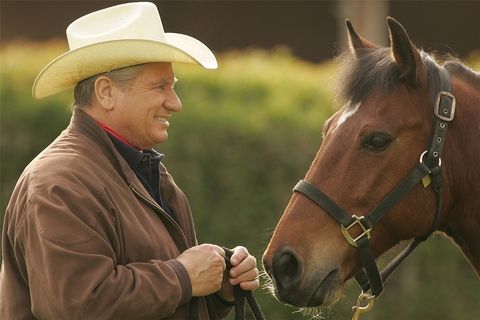
Before there was the “Dog whisperer” on television, there was the Horse whisperer. Monty Roberts was raised in the horse business. He learned that there was one way to train horses - by “breaking” them through domination and force which at times included striking the horse with whips or tying and suspending the horse’s feet and legs. The trainer would impose his will upon the animal until it reached the conclusion that total submission was the only way to survive.

In his early teen years Roberts began to study the behavior and communication patterns of wild mustangs in the badlands of Nevada. He took note of the nonverbal communication among the horses, their body language. He named this kind of horse language "Equus." Drawing on his observation and firsthand experience with horses, Roberts developed a breakthrough training technique that he called “hooking on to” rather than “breaking down” the horse’s will. This new training method was based on a concept he eventually trademarked “Join-Up.”

“Join-Up” not only stopped the “breaking” practice of traditional horse training, but it demonstrated how to cooperate with the horse’s own spirit, ways, and means of communicating as a member of the herd. His techniques laid the platform for a partnership between horse and human rather than a coexistence through domination. The personality and full potential of the horse emerge through a loving freedom and desire rather than domination and infliction. Join-Up relies on invitation rather than imposition.

The Join-Up technique invites an untamed horse that has never been ridden to willingly accept the saddle, bridle, and rider. It is a thing of beauty to watch. Monty Roberts enters a round pen with a wild horse. In as little as half an hour, he’ll be riding the horse. Roberts creates an atmosphere of mutual respect that communicates, “I’m not going to hurt you, and you don’t have to follow me if you don’t want to.”

After a brief period of introducing himself and interacting with the horse comes the moment of truth.
Roberts turns his back to the animal and walks away. At this point the horse trains her eyes on Monty with all-out intensity and attention. She is asking herself, Where is he going? and Do I want to stay by myself? The horse must choose: I want to be with you. I want to join up and follow you on the way. She quickly decides: my safe place is with you. Dropping her head (equine language for “I submit to you”) and trotting to Roberts’ side, the horse says, “I choose to follow. I want to be with you.”

That is the Jesus way. Jesus did not come into this world and command us to submit to Him. He came into this world showing us what true love is all about and inviting us to walk along side Him. The Jesus way is our cooperation with Jesus’ “Follow Me.” This is Jesus’ call to all of us.

What do I want to be when I grow up? I want to follow Jesus, I am working on it, but what does it mean to follow Jesus. The Greek word translated “follow” is most often rooted in the word for “road.” There is an ancient African phrase, “Will you walk with me?” It doesn’t mean a stroll or short jaunt around the corner. It means to enter another person’s world, to join his or her journey. To walk with Jesus does not mean to travel behind or in front of but beside him. To follow Jesus on the way doesn’t mean to fall in behind him in a directional sense but to be caught up in what he is doing. Discipleship is the art of being a pilgrim - the artistry of following Jesus. It is to be caught up in what God is doing in the world today.

Imagine you opened your e-mail in-box and discovered you had received an invitation from some superstar - maybe Phil Mickelson - “Come, be with me, and I will teach you everything I know about golf.” Or maybe you would get a call from someone like Bill Gates who wants you to walk with Him and learn how to become successful in business. For those of you who love to sing, what would your reaction be if you received a phone call from Celine Dion, asking, “Will you come and stay with me for a couple of years? I will teach you to sing like me”? For aspiring writers, how incredible would it be to answer a knock at the door and find Maya Angelou inquiring, “Would you like to hang out with me and learn how to write?”

Jesus Himself is calling you to follow Him and learn how to live. There seems to be a natural progression that Jesus proposed: In John 14:6 Jesus said "I am the way and the truth and the life. No one comes to the Father except through me. To follow Jesus is to be in the right mission (the way: missional living); to follow Jesus is to be in the right relationships (the truth: relational living.)  To follow Jesus is to be in the right future (the life: incarnational living.) Step 1 is belonging, Step 2 is believing, then step 3 is behaving.

 “When Jesus summoned people into the way, he was inviting them to share a purpose or path (the way), a new set of relationships (the truth), and the beauty of community ( the life). If Jesus is the way, the truth, and the life, then His way must be our way, his truth must be our truth, and his life must be our life.” [Leonard Sweet]


“The Jesus way wedded to the Jesus truth brings about the Jesus life.” [Eugene Peterson]


First, we must choose to get on the journey with him—trust him as the “Way.” We realize we want to be with him, to submit to His leadership. The first followers of Jesus were known as those who belonged to “the Way.” They had a way about them. Theirs was not just a shared system of belief that included religious traditions and mystical idiosyncrasies. There were plenty of sects in Jesus’ time like that. But something was different here. These people had a way about how they went about their lives, a way of being that had not been witnessed before. There was something very different about the way these people treated one another, - both insiders and outsiders.

Dictionaries define the word “way” variously—as a habitual manner or characteristic, a method, a direction or vicinity, a passage or path. All of those definitions capture parts of the essence of following Jesus. But followers of Jesus don’t just submit to Jesus’ codes and conduct. They don’t just join him in following a certain path, live in his voice, practice a certain presence from earth to eternity. Most important, the path with Jesus leads to Jesus; the path of life leads to life.

Second, we choose to answer the question, what is truth? This was Pilate’s world-weary question to Jesus, but Pilate was staring in the face of Truth and didn’t know it. Jesus is the Truth, for truth is a Person,not a principle. This relational view of truth contrasts starkly with the world’s way of thinking and demands more than mere intellectual assent. It requires obedience. A follower of the truth is one who follows upon, who trusts and obeys One who is Truth.

Third, we begin to get a life, not a half-life, not term life, but whole life. We learn to re-frame our living based on always pilgriming and always sharing life with Jesus so that “it is no longer I who live, but Christ who lives in me.” A wayfarer of the life is one who follows so closely that his or her life aligns with the life of the Leader. Note that this template is not only sequential but also simultaneous. We are always on the way, we are always learning more and more about the truth, and we are always gaining more and more of that abundant life Jesus talked about in John 10:10. To follow Jesus is a way - a belonging; is a truth - a believing; is a life - a behaving. It is to have a mission, to be in relationship, to live an incarnate, abundant life.

What does it take to be a Courageous Follower of Jesus:

  • The courage to assume responsibility.
  • The courage to be a servant
  • The courage to challenge.
  • The courage to participate in transformation.
  • The courage to take moral action.

Jesus is summoning you:  “Come, follow me. Come, be with me, and I will do more than teach you the way to live your one and only life. I will give you life.”